
How DeskSnap Recovered Its Product Architecture
DeskSnap already had working functionality, but new features repeatedly interfered with existing systems because the product lacked one governing architecture.
Case at a glance
- Product
- Desktop workspace continuity and restoration
- Starting problem
- Features conflicted and created hidden weaknesses
- Critical systems
- Licensing, browser extension, local restore and cloud continuity
- Recovered center
- Reliable personal workspace continuity
- New direction
- Restore cloud-shared layouts across multiple devices
- Current status
- Recovery verified; implementation underway
The situation before Driftbreak
Liam understood what DeskSnap was supposed to do and knew how to build individual features. The problem was that those features were not governed by one stable architecture. As more functionality was added, one part of the app could create problems in another. That made bugs harder to predict and made a stable consumer release increasingly difficult.
What Driftbreak exposed
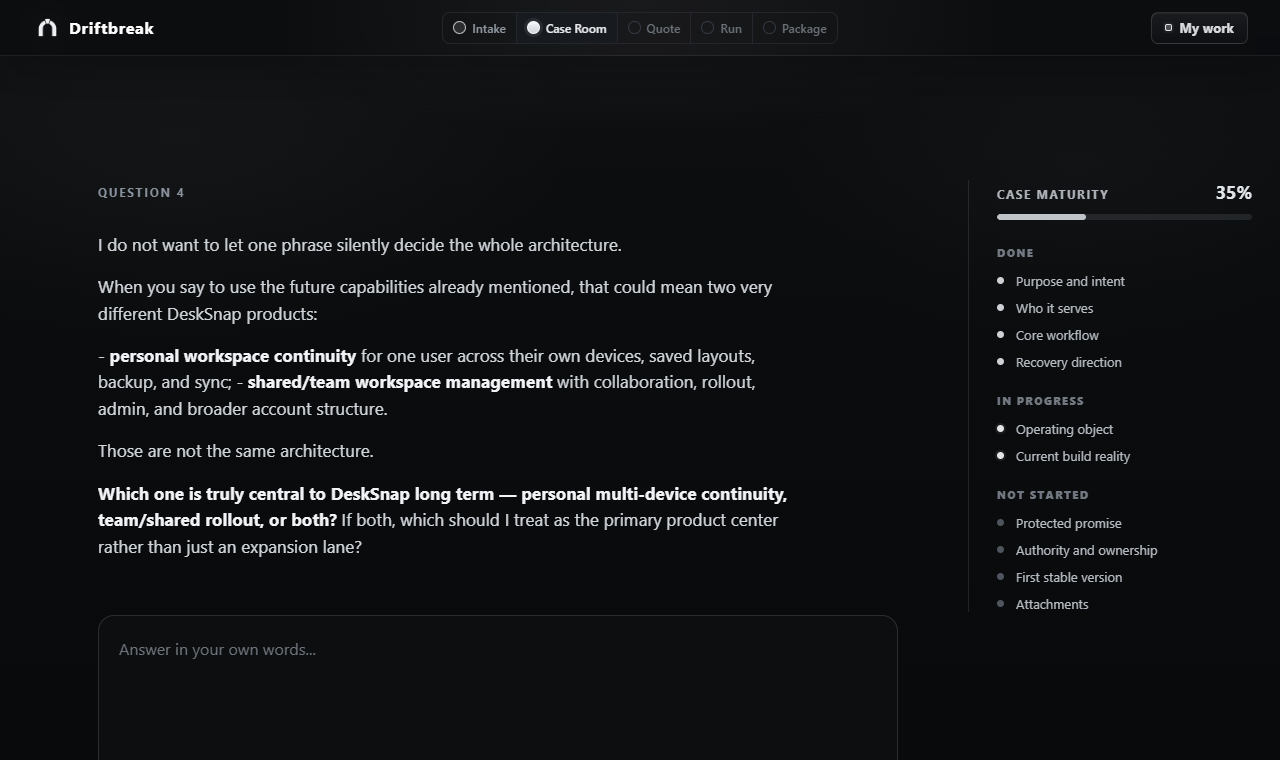
The Case Room did not only ask Liam to describe his app. It challenged unresolved decisions affecting the product: whether DeskSnap should center on reliable personal workspace continuity or expand too early into broader shared and collaborative behavior.
- Personal workspace continuity needed to remain the product center.
- Team collaboration could not silently overtake the first trustworthy version.
- Licensing, browser-extension behavior, local state, and cloud behavior needed explicit boundaries.
The decision Driftbreak helped lock
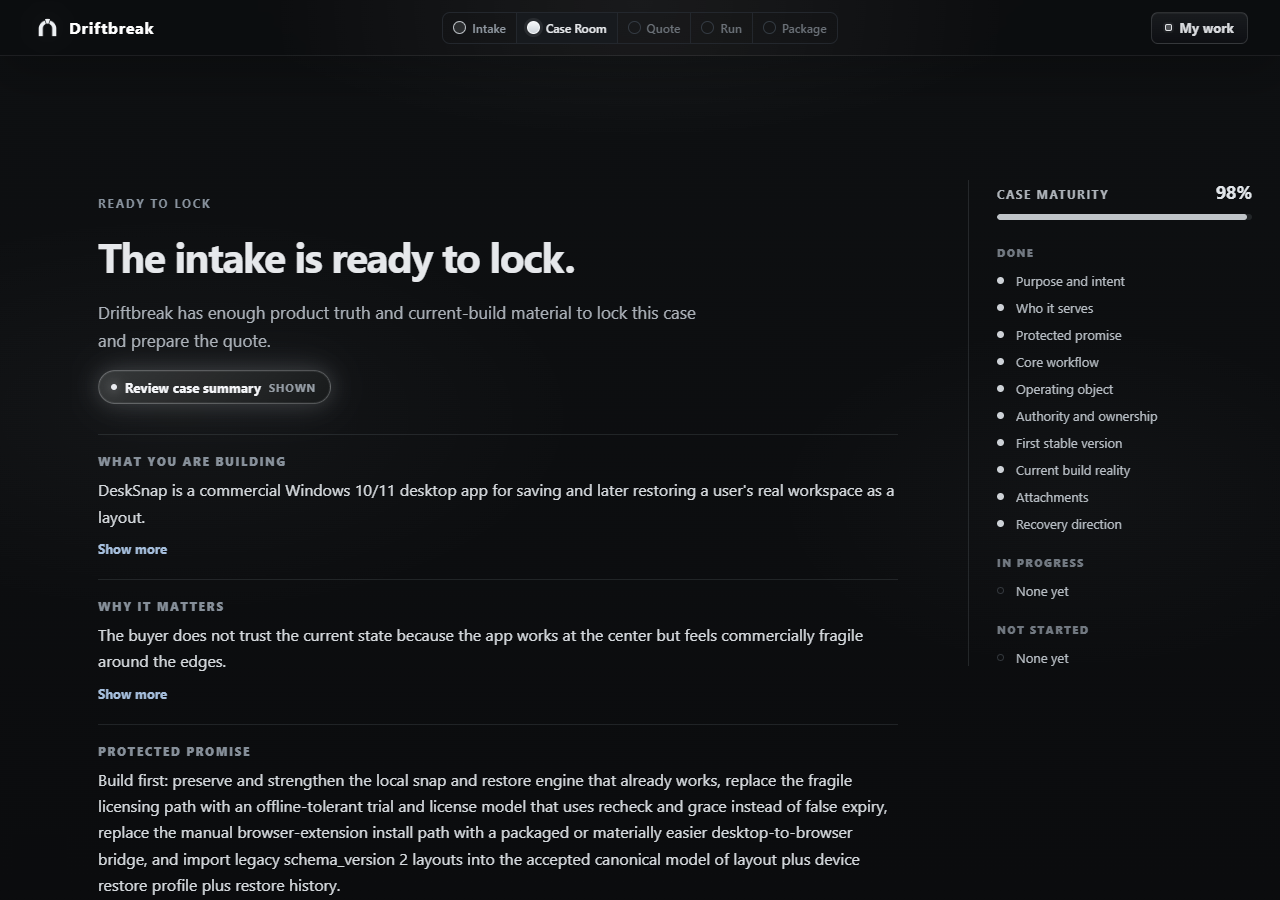
The recovery changed the next move from continue building remaining functionality and dealing with problems as they appear to stabilizing the existing product from beginning to end, repairing critical licensing and extension paths, preserving the central restore experience, and then introducing a bounded set of accepted new capabilities.
- Debug the existing DeskSnap flow from beginning to end.
- Stabilize licensing and browser-extension behavior.
- Preserve the local workspace restoration foundation.
- Implement three accepted capabilities.
- Add settings and controls required to govern those capabilities.
A product direction Liam had not considered
One recommendation was to let a layout shared through the cloud be restored across multiple devices. That could let someone save or share one workspace layout, access it from another device, restore the same working environment, and preserve continuity without manually rebuilding the workspace.
From recovery decision to implementation authority
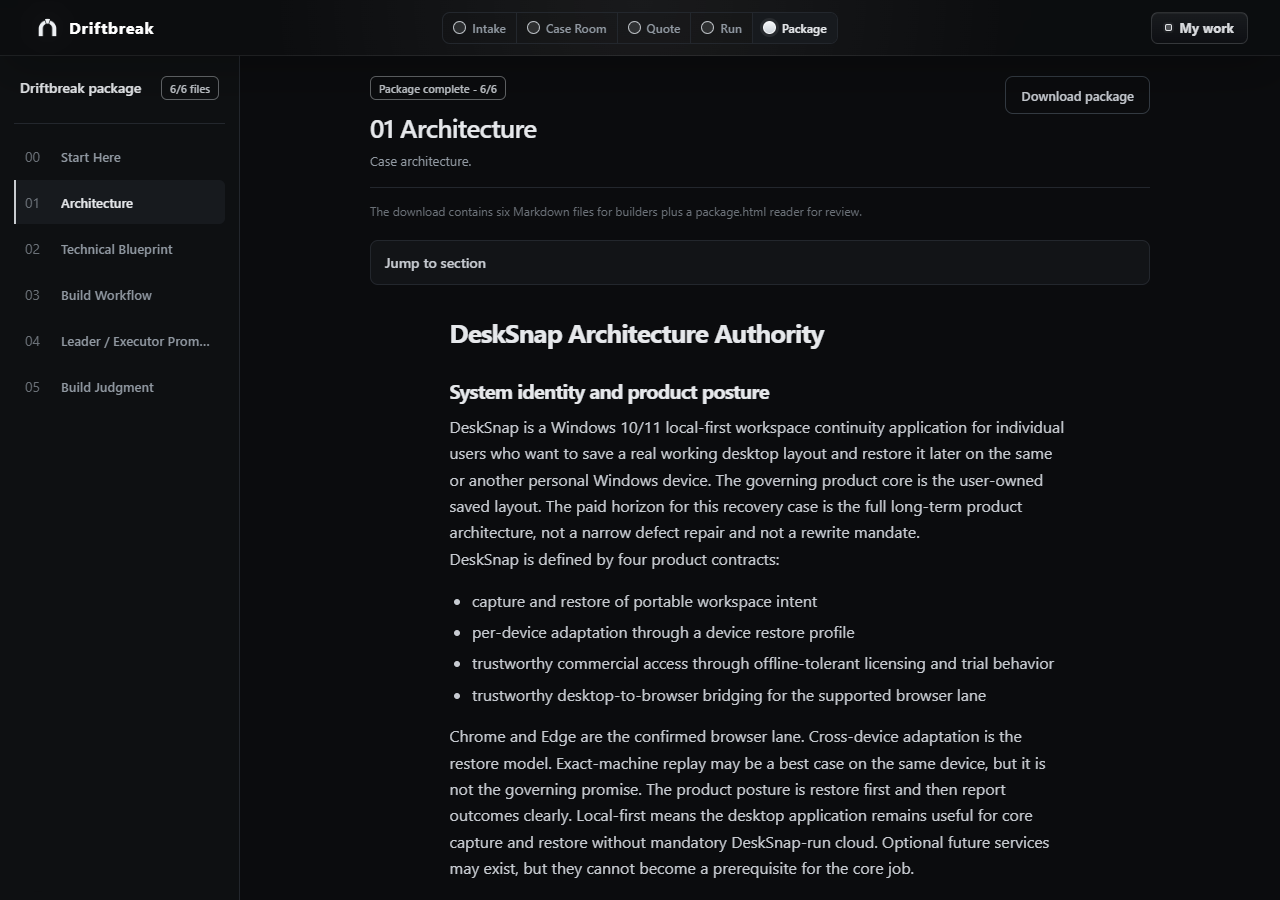
Once Liam confirmed the recovered direction, Driftbreak generated a six-part implementation package: operating guide, architecture, technical blueprint, build workflow, leader/executor prompts, and build judgment. The package carried forward the decisions confirmed during the Case Room rather than merely repeating the original idea.
Current status
The recovery outcome and generated direction have been verified. DeskSnap implementation is still underway, and this case study will be updated with concrete build results.
Before and after
Continue adding functionality
Stabilize the complete flow first
Features could interfere with each other
Systems and boundaries received explicit authority
Licensing failed unpredictably
Licensing became a critical recovery path
Browser and cloud behavior were unclear
Desktop, browser and cloud responsibilities were separated
No cross-device restoration concept
Cloud-shared layouts could restore across devices
Product completion kept moving
A bounded implementation sequence was established
Result so far
Verified recovery outcomes
- Liam completed the Case Room without founder guidance.
- Driftbreak exposed product and architectural conflicts.
- The central DeskSnap direction became clearer.
- Uncertainty around what to build next was reduced.
- A valuable cross-device feature was discovered.
- The immediate work changed from feature expansion to foundation stabilization.
- A case-specific architecture and implementation package was generated.
- Liam began using the package while working on DeskSnap.
Still being observed
- Final implementation quality is still being verified.
- Launch results, revenue, and long-term stability are not yet known.
- Implementation is continuing, so measurable development-speed improvements are not yet available.
This case study will be updated as implementation continues.
Builder assessment
It was like building a boat with a bunch of small hidden holes. I knew how the boat worked and how to build it, but my lack of proper architecture kept leaving weaknesses that could ruin the whole thing.
The intake helped me discover parts of the product I had not properly considered and removed a lot of uncertainty.
The blueprint was one of the strongest parts. It gave me a much clearer idea of what the full project should become and how the pieces should work together.
Liam — builder of DeskSnap
Continue with the relevant evidence
Follow the relevant product decision, implementation guide, or approved case evidence.
Should I rewrite my AI-built app, refactor it, or keep building?
Do not choose a rewrite from the size of the mess alone. Identify what works, what owns important state, what users rely on, and whether a bounded repair can restore a complete journey. Rebuild only the boundary the evidence justifies.
Read nextGuideMy AI-built app works, but I am afraid to change it. What now?
Do not start by rewriting a working app. First identify one important user journey, what currently owns its state, and what must remain true when it changes. Then make and verify one bounded change.
Read nextGuideWhen your AI-built app has three different sources of truth
Many ?random bugs? are really authority conflicts: the interface, the database, and the AI instructions each believe they own the same decision.
Read nextYour app may not need another feature
It may need one trustworthy definition of what the product is, what should survive, and what your coding agent should build next.
Open a case - free